
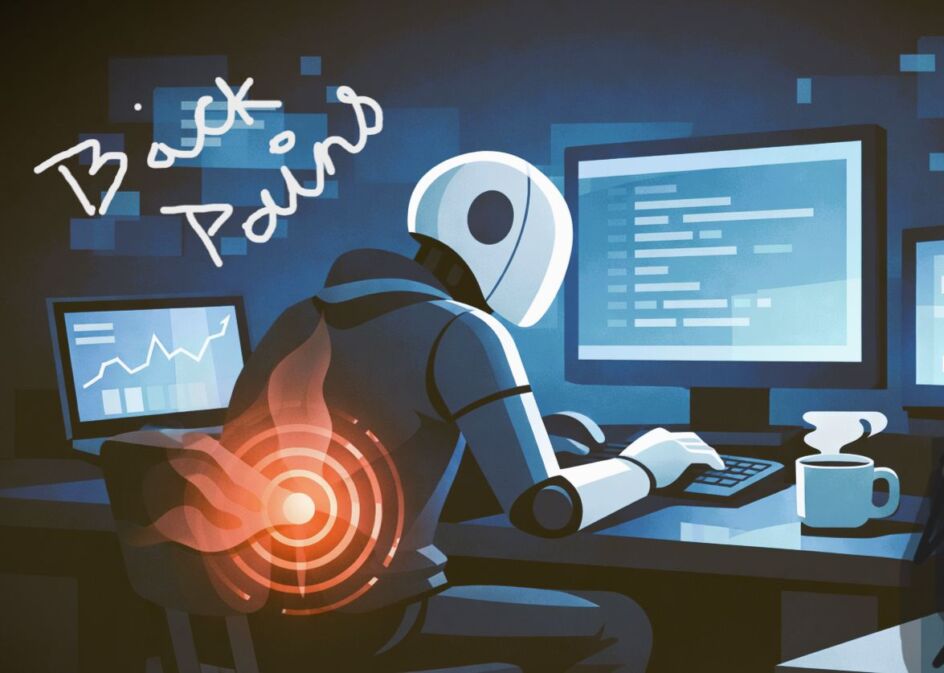
It’s 3:30 am, and you feel that throbbing, painful feeling around your lower back. You change your position, thinking a shift of position can help you ease your pain, but this is just the beginning. You are unable to get into deep sleep because of the discomfort. Every effort you make to feel relaxed goes in vain. You’re circling in the never-ending cycle of exhaustion.
I’m exploring this topic not just as a matter of health issue, but through my research lens and my real life observations. Back pain, anxiety, and forgetfulness. Do these sound familiar? The obvious answer is yes.
The studies on back pain intensity and lack of sleep
A study of 1,055 older male participants was done. This was about completing two sleep study visits 6 years or more apart. Sleep issues were noted alongside back pain severity and frequency. So, they noted their severity of back pain before 6 years and the one 6 years after.
Most of those from 25 to 55 years of age and over may find the following issue very well known to them, either with themselves or within their family members. I’d like you to know the results of the study done by the researchers at Penn State university.
This research validates partly the connection between ageing and the lack of sleep. It was back pain that predicted an increase in future sleep problems and not the other way round. This study, like many others, had limitations. It was only done on male participants.
Another study where 1,941 patients’ data was obtained from 13 studies between 2001 and 2009, found sleep disturbance is common in patients with Lower back pain. The findings also revealed that the intensity of back pain was only weakly associated with sleep disturbance, which suggested other factors contributed to sleep problems for low back pain patients.
Insufficient sleep, dark circles, light-headedness, irritation, sweat, feeling itchy, anxiety, forgetfulness, and issues with their temper are all familiar problems. Medically, there may be several reasons.
Not many of us have the luxury to repay our sleep debt. Based on our circumstances and weather conditions our sleep suffers, as a result we pay the price.
The following are the amplifying factors that this study has not entirely captured
Work night shifts and the connection with backache: Those who work night shifts get paid a bit more than the daytime or the office-time employees. Just as there is a high salary where there is a higher risk. In fact, an article in the British Medical Journal about the study on rotating shift work with night shift work unveils a cardiovascular risk factor and its connection with night shift work.
Sleep and the circadian rhythm: It isn’t about the amount of sleep you get, but it is about the disruption of our circadian rhythm. We came across cases of heart problems, indigestion, and light-headedness in night shift call centre employees, especially the ones that were on desk jobs. We are at a stage where tech advancement has led to the change in the job roles. Emphasis on desk jobs and remote work started to accelerate; may be next five years it could result in a tremendous health issue.
A journal article from Innovation in Ageing from volume 9 issue 11 2025, adds the lifestyle behaviours, physical activity, the nutrition and sleep as an important factor in expression and the severity of the back pain. From what we understand, back problem predicted sleep problems and not vice versa.
Real world observations
The Gender Gap: HuffPost’s Ariana Huffington’s sleep revolution also emphasizes on the importance of better sleep. She’s has helped fill the gap in raising the issue of women and good sleep. I still remember her TED talk in which she cracked a joke about Lehman Brothers, ‘if Lehman Brothers was Lehman Brothers and Sisters, it might still be around…’
Disciplined life: My Grandpa was over hundred-year-old, and he never complained about back pain. He had a set time to go to sleep at 9:30 pm and wake up early morning, go for a morning walk, and his work involved physical work during the daytime. Not only a personal experience, but also there are a set of elderly people who live a healthy lifestyle because of, perhaps, an unconsciously disciplined living.
The purpose is to eliminate enormous exertion that you might have to endure due to insufficient sleep. Here’s the take away for you: consistent sleep schedule + daytime physical activity + minimal sedentary time = a century without back pain.
Our Modern Reality: I agree we all cannot live like my grandpa. Our goal is also not to become a farmer or a manual labourer, not that there’s anything wrong with it. The point here is to integrate his principles to our modern life.
Breaking this endless cycle that has already started
1: Make Movement your medicine: take advantage of the systems. There are many names in different cultures, but most popularly this is also know as the Pomodoro technique. Set a timer to stand/stretch every 30 minutes. Use reminder apps. Take a daily 10-minute walk—not for fitness, but for spinal lubrication and inflammation reduction. We’ve learnt in the past that 20 minute brisk walk helps.
Ergonomic set up—laptop stands, supportive chairs, indoor plants around you. The goal is to stop pouring fuel (poor posture) on the fire (pain).
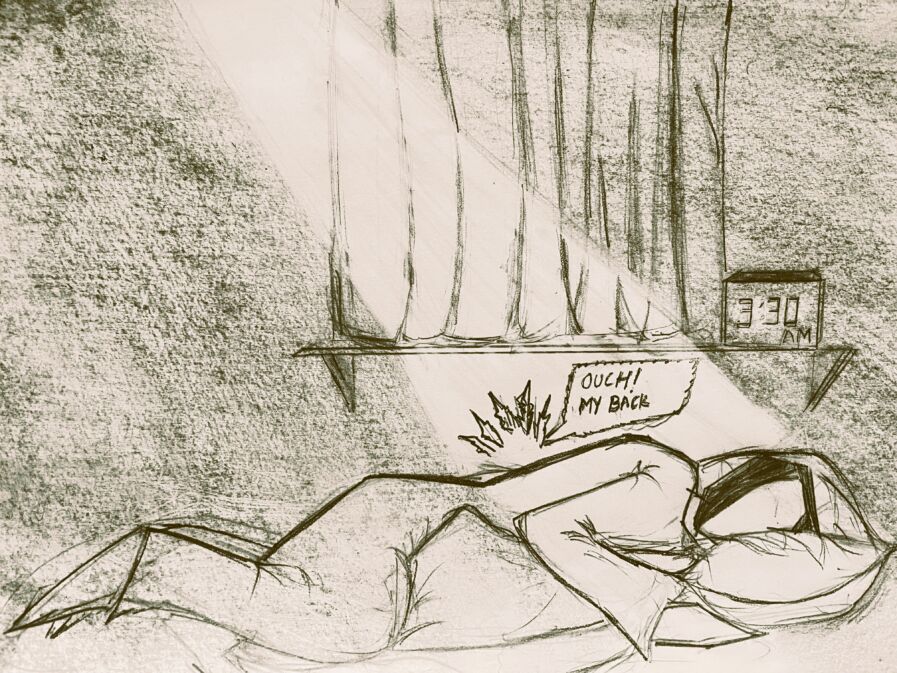
2: Make your sleep sanctury and rest for recovery. For a night shift worker or an anxious mind: create a sleep-conducive environment around you. I can understand because I faced this issue myself. It takes time for things to settle down and get better. Avoid using display screens 1 hour before you sleep; you can add more time if you wish. You can practice 2 minutes of deep breathing to lower anxiety.
Sleep Position: Sleep on your side with a pillow between knees or back sleeping with a pillow under knees. This is a non-negotiable, low-cost hack. My personal experience has taught me to sleep on the right side.
I can’t emphasize this enough but sleeping at the same time everyday can help. It is more powerful than a supplement regulating your sleep-pain cycle.
While The Penn State study reveals a hard truth: untreated back pain is like an open wound that doesn’t let you sleep. My grandfather’s century of pain-free sleep reveals the antidote: disciplined rhythm. The Pain is real, but let’s see if we can interrupt the loop.
Conclusion
We don’t have any control over our past life experience and injuries, but we can take few baby steps at a time as a change in our life. Going to sleep on time, stretches, going for a walk, consistent sleep time, reducing the screen time and some minor practices we can inculcate in our daily life to stop this cycle where it stands.
We cannot imagine being completely pain free forever or enjoying a zenful sleep, but we can work towards it, so we don’t affect one at the cost of the other. Sleep on your side, place a pillow between the knees, and sleeping on time. Let’s knock the sleep thief off our life. Share this article if you feel the same way I do and Tag me if you can.
References:
- Huffington, A. (2010). Sleep Your Way to the Top. [Video]. YouTube. Available at: https://www.youtube.com/watch?v=nncY-MA1Iu8 (Accessed: 20 January 2026).
- Alsaadi, S.M., McAuley, J.H., Hush, J.M., Maher, C.G. (2011). Prevalence of sleep disturbance in patients with low back pain. European Spine Journal, 20(5), pp. 737-743. DOI: https://agsjournals.onlinelibrary.wiley.com/doi/abs/10.1111/j.1532-5415.2007.01399.x
- Penn State University (2025). Back pain linked to worse sleep years later in men over 65, according to study. Available at: https://www.psu.edu/news/health-and-human-development/story/back-pain-linked-worse-sleep-years-later-men-over-65-according (Accessed: 23 January 2026).
- Alsaadi SM, McAuley JH, Hush JM, Maher CG. Prevalence of sleep disturbance in patients with low back pain. Eur Spine J. 2011 May;20(5):737-43. doi: 10.1007/s00586-010-1661-x. Epub 2010 Dec 29. Erratum in: Eur Spine J. 2012 Mar;21(3):554-60. doi: 10.1007/s00586-011-1954-8. PMID: 21190045; PMCID: PMC3082679.
- Skogstad M, Alsaedi S, Sirnes PA, et al. Rotating shift work, with night shift work, affects cardiovascular risk factors: a 6-year follow-up study in the insulation industry. Occupational and Environmental Medicine 2025;82:326-334.
