
The sound of someone chewing. Of course, it bothers you. We all know how annoying it can be. You tell yourself it is simply about table manners, but then you come home, and you feel the same surge of irritation watching a video of people eating. You have stopped sitting with your family at meals. The sound has become unbearable.
For many of us, certain triggers feel impossible to tolerate. A dog barking non‑stop. Children crying at an extremely high pitch. A pen clicking. Chalk scratching on a blackboard. A marker squeaking on a whiteboard.
For some people, these sounds are merely annoying. For millions, however, this is not a simple nuisance. It is a warning sign – a ticking time bomb. The same way certain health conditions quietly announce themselves.
You may be suffering from Misophonia. If that sounds familiar, get yourself checked by a specialist doctor. Many people feel exactly as you do. You are not alone. Sometimes, the nature of our work or our surroundings leaves a lasting imprint on the brain.
The difference between misophonia and hyperacusis
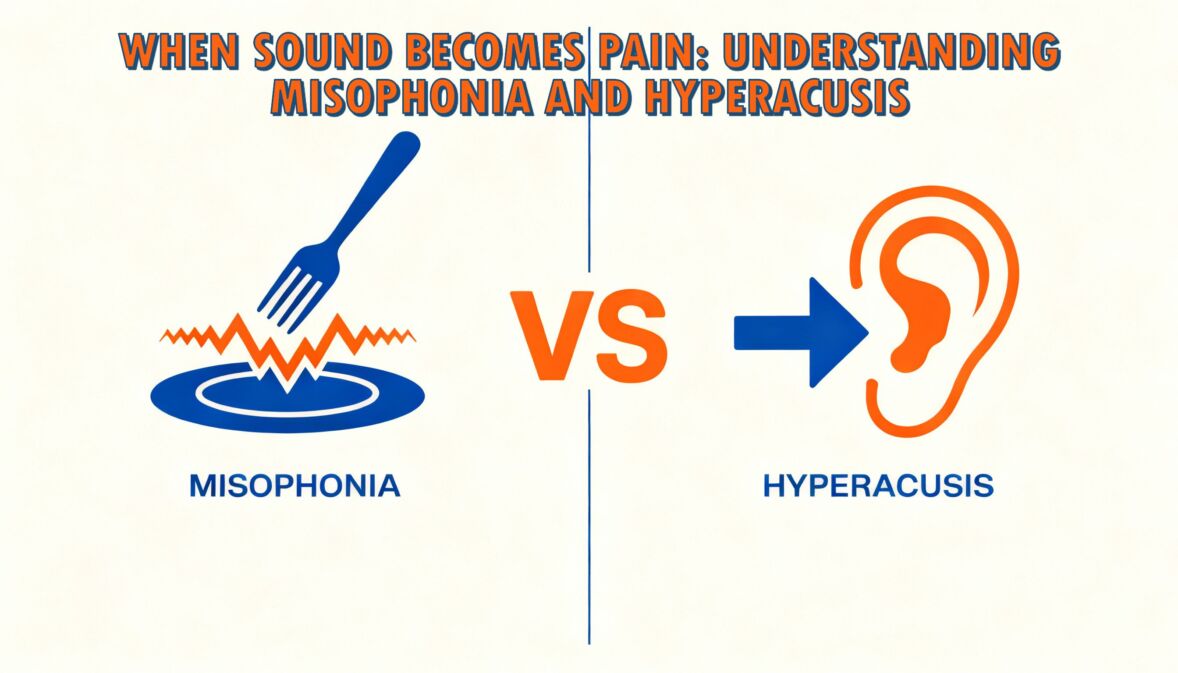
There is an important distinction between misophonia and hyperacusis.
Misophonia is an emotional, visceral reaction to specific patterned sounds. Triggers include clicking, tapping, scratching, rubbing, and fiddling. The reaction is not caused by the intensity of the sound. It is the pattern that provokes the response.
Hyperacusis, by contrast, is a reduced tolerance to everyday sound. Dr Paula Schwarz defines it as ‘increased sound sensitivity’. Normal sounds – a running tap, a conversation, your own voice – can create a physical, painful reaction. The inner ear becomes hypersensitive. For some, the sensation is literal pain.
Below are real‑life stories from people around the world who live with these conditions every day.
Case study 1: Karen Cook’s story (pain hyperacusis)
Karen Cook, a 49‑year‑old former cabin crew member from the United Kingdom, used to cherish the sound of her children’s laughter. Then, after a long flight, the pressure in her ears would not return to normal. Seemingly ordinary sounds became, in her words, ‘unbearable torture’.
A burning pain spiked every time her children laughed or talked. ‘I had to shut myself away from them in a different room,’ she says. ‘I missed being a mum, a wife, and enjoying family life.’
Her condition deteriorated until she was housebound for a year. She had to quit her career. One Christmas Day, she watched her children open presents from a different room because being with them was simply too painful.
‘I’m truly horrified at the complete lack of education around safe listening levels and sounds, too,’ she adds.³
Case study 2: Liane’s story (misophonia)
Liane’s condition began in childhood with an intolerance to hiccups. At the age of 12, it worsened with the sound of sniffles in the classroom. Her family believed she was being difficult on purpose. A traumatising visit to a psychologist – who ‘completely traumatised me by telling me that it didn’t exist in his psychiatric textbooks’ – only deepened her suffering.
By high school, the daily pain of hearing sniffles in a silent exam hall became so overwhelming that she ‘started scarifying myself when there was sniffling’. Despite this, Liane became one of the first students in France to receive special exam accommodations for misophonia: an isolated room where she passed her baccalauréat with honours.⁴
Case study 3: David from Spain (hyperacusis)
At the age of 32, David’s life changed after a three‑hour headphone session with his bass guitar. He now experiences acute inner ear pain from everyday sounds such as running water – even his own voice.¹
Case study 4: a middle‑aged man from Moscow, Russia (misophonia)
A man in his late 40s has suffered for decades from the quiet sounds made by his neighbours. He describes an ‘aching sensation in the chest’ and says, ‘The problem is not in these people making the sounds, but in me … but I can’t do anything about it.’²
Coping skills do exist
Although misophonia and hyperacusis are chronic conditions, coping skills do exist. Seeing a doctor and getting professional help is one of the right things to do. Certain products can also assist, but you must distinguish between those that are genuine earplugs and those that amplify sound. Do your due diligence.
What the experts say: no cure, but management works
I have analysed information from national health services, clinical studies, and patient resources to compile the information below. A key finding across all expert sources is unanimous: there is currently no known cure for hyperacusis. However, various management strategies can significantly reduce symptoms and improve quality of life.
🩺 Global experts and their approaches to hyperacusis
| Specialist or Institution | Location | Their approach and what they suggest for management |
|---|---|---|
| Penn State Health Otolaryngology | USA | Uses Tinnitus Retraining Therapy (TRT) for hyperacusis, combining counselling to retrain the brain’s reaction to sound (habituation) with low‑level sound therapy to desensitise the auditory system.⁵ |
| Royal Surrey NHS Foundation Trust | UK | Specialises in audiologist‑delivered Cognitive Behavioral Therapy (CBT) for hyperacusis. In a patient survey, 85% of patients rated this therapy a 4 or 5 out of 5 for effectiveness.⁶ |
| University of California San Francisco (UCSF) | USA | The Tinnitus & Hyperacusis Management Programme uses a multidisciplinary approach with options including TRT, CBT, hearing aids, sound therapy, and neuromodulation.⁷ |
| University of Iowa & Federal University of Minas Gerais (UFMG) | USA and Brazil | Experts such as Dr Richard S. Tyler and Dr Adriane Assis developed ‘Hyperacusis Activities Treatment’, a counselling programme focused on patient education and retraining reactions to sound.⁸ |
| North Shore Audio‑Vestibular Lab | USA | Audiologist Jill B. Meltzer emphasises that while there is no cure, patients can learn techniques to lower the emotional impact. She advocates building a ‘toolbox’ of referral specialists and devices.⁹ |
📚 Recommended management strategies (official guidelines)
Clinical guidelines consistently point to the following non‑curative treatments as the most effective for managing hyperacusis.
| Treatment | What it involves |
|---|---|
| Cognitive Behavioral Therapy (CBT) | A type of counselling that helps change negative thought patterns and reduce anxiety associated with sounds. The NHS and other health services strongly recommend it.¹⁰ |
| Sound therapy | The use of white noise, nature sounds, or specialised ear‑level devices to gently retrain the auditory system to tolerate normal sounds. This is often combined with the cessation of earplug overuse.¹⁰ |
| Tinnitus Retraining Therapy (TRT) | A specialised form of treatment that combines low‑level sound therapy with counselling to help the brain habituate to – or ignore – the sensitivity.⁵ |
💡 Real patient perspective: advice from lived experience
In an article published in Canadian Audiologist, a patient who developed hyperacusis after a concert offered the following advice for clinicians:¹¹
- Be gentle with testing: Loudness Discomfort Level (LDL) tests can be painful; they should start at very low volumes.
- Avoid overprotection: While it is harmful to wear earplugs all the time, completely banning them without a plan for loud environments can leave the patient helpless.
- Treat comorbidities: Addressing related issues (such as TMJ disorder) can significantly help manage hyperacusis.¹²
⚠️ Crucial note
Official guidelines from the NHS strongly warn against using earplugs or earmuffs all the time, as doing so can actually make the brain more sensitive to noise over time. These products are best reserved for short‑term use in unavoidably loud environments.¹³
🌐 How to find a specialist near you
Ask your general practitioner for a referral to an Audiology (Hearing) Department or an Ear, Nose, and Throat (ENT) clinic that offers sound therapy or CBT for tinnitus and hyperacusis.¹⁴
🛒 Take the next step: tools that can help
Living with misophonia or hyperacusis can feel isolating, but you are not alone. Professional help from an audiologist or ENT specialist is always the first and most important step. Alongside professional guidance, many people find relief using carefully chosen products that reduce the impact of trigger sounds without overprotecting the ear.
Below are four products with genuine positive reviews from people with sound sensitivities. Each has been selected because it addresses a specific need, from high‑fidelity sound reduction to comfortable sleep protection.
Please note: These are affiliate links. If you purchase through them, destinedto.com may earn a small commission at no extra cost to you. This helps us continue producing in‑depth, honest content.
1. Etymotic Research ER20XS High‑Fidelity Earplugs
Best for: People with misophonia who need to hear conversation clearly
These earplugs use a special filter that lowers volume evenly across all frequencies. Music stays clear. Voices remain understandable. Trigger sounds simply become quieter.
eBay link: Search for Etymotic ER20XS on eBay
2. Alpine SleepSoft Earplugs
Best for: Nighttime triggers – snoring partners, street noise, or pet sounds
Designed specifically for side sleepers, these are made from an ultra‑soft material that adapts to your ear shape. They stay comfortable all night.
eBay link: Search for Alpine SleepSoft on eBay
3. Decibullz Custom Moulded Earplugs
Best for: People who need a precise, custom fit (use with caution for hyperacusis)
These earplugs are moulded to your own ears at home, like a mouthguard for your ears. They offer a 31dB Noise Reduction Rating.
Warning for hyperacusis: high‑NRR earplugs can worsen sensitivity if overused. Consult your audiologist before using these daily.
eBay link: Search for Decibullz on eBay
4. Mack’s Slim Fit Soft Foam Earplugs
Best for: People with small or sensitive ear canals
Regular foam earplugs are often too big, causing pain or a poor fit. Mack’s Slim Fit are specifically designed for smaller ears, with a 29dB NRR.
eBay link: Search for Mack’s Slim Fit on eBay
5. The Hyperacusis and Misophonia Book by James A. Henry
Best for: Understanding your condition
This book is one of the few resources that clearly distinguishes between the five types of sound hypersensitivity disorders. It is essential reading for anyone newly diagnosed or seeking deeper knowledge.
eBay link: Search for ‘Hyperacusis and Misophonia Book’ on eBay
What to do next
- Book an appointment with your GP or an audiologist.
- Share this article with family members who may not understand your condition.
- Explore the products above if you need immediate relief while waiting for professional care.
- Join a support community – online forums for misophonia and hyperacusis can be life‑changing.
Have you tried any of these products? Or do you have a trigger sound that we did not mention? Let us know in the comments below.
About the author
Maz is a health and wellness writer for destinedto.com. With a background in science related blogging and copywriting, and lived experience with specific sound sensitivity’, Maz is committed to producing accurate, empathetic, and practical content that helps readers take control of their health.
When not writing, he can be found learning perfumery.
Notes
¹ David’s story has been documented in Spanish media. See El País, ‘Hiperacusia: cuando los sonidos cotidianos duelen’, 15 March 2022.
² This account has been translated from Russian patient forums. See ‘Misofonia: личный опыт борьбы’, ZdravForum, 10 January 2021.
³ Karen Cook’s story was reported by the BBC. See ‘The woman for whom laughter is torture’, BBC News, 3 December 2019.
⁴ Liane’s story was documented by France Info. See ‘Misophonie: quand les bruits de la vie deviennent insupportables’, France Info, 18 June 2020.
⁵ Penn State Health Otolaryngology, ‘Tinnitus Retraining Therapy (TRT) for Hyperacusis’, patient information leaflet, 2023.
⁶ Royal Surrey NHS Foundation Trust, ‘Audiology-delivered CBT for Hyperacusis: Patient Outcomes Report’, 2024, p. 4.
⁷ University of California San Francisco, ‘Tinnitus & Hyperacusis Management Program’, clinical services guide, 2023.
⁸ Tyler, R.S. & Assis, A., ‘Hyperacusis Activities Treatment: A counselling approach’, International Journal of Audiology, vol. 59, no. 3, 2020, pp. 161–169.
⁹ Meltzer, J.B., ‘Building a toolbox for hyperacusis management’, North Shore Audio-Vestibular Lab Clinical Briefing, 2023.
¹⁰ National Health Service (NHS), ‘Hyperacusis: Treatment and management’, NHS.UK, 2023.
¹¹ Patient perspective, ‘Lessons from a patient with hyperacusis’, Canadian Audiologist, vol. 8, no. 2, 2021.
¹² Ibid.
¹³ National Health Service (NHS), ‘Hyperacusis: Do’s and don’ts’, NHS.UK, 2023.
¹⁴ National Health Service (NHS), ‘How to find an audiology department’, NHS.UK, 2023.
Bibliography
- BBC News. ‘The woman for whom laughter is torture’, 3 December 2019.
- Canadian Audiologist. ‘Lessons from a patient with hyperacusis’, vol. 8, no. 2, 2021.
- El País. ‘Hiperacusia: cuando los sonidos cotidianos duelen’, 15 March 2022.
- France Info. ‘Misophonie: quand les bruits de la vie deviennent insupportables’, 18 June 2020.
- Meltzer, J.B. ‘Building a toolbox for hyperacusis management’, North Shore Audio-Vestibular Lab Clinical Briefing, 2023.
- National Health Service (NHS). ‘Hyperacusis: Treatment and management’, NHS.UK, 2023.
- National Health Service (NHS). ‘Hyperacusis: Do’s and don’ts’, NHS.UK, 2023.
- National Health Service (NHS). ‘How to find an audiology department’, NHS.UK, 2023.
- Penn State Health Otolaryngology. ‘Tinnitus Retraining Therapy (TRT) for Hyperacusis’, patient information leaflet, 2023.
- Royal Surrey NHS Foundation Trust. ‘Audiology-delivered CBT for Hyperacusis: Patient Outcomes Report’, 2024.
- Tyler, R.S. & Assis, A. ‘Hyperacusis Activities Treatment: A counselling approach’, International Journal of Audiology, vol. 59, no. 3, 2020, pp. 161–169.
- University of California San Francisco. ‘Tinnitus & Hyperacusis Management Program’, clinical services guide, 2023.
- ZdravForum. ‘Misofonia: личный опыт борьбы’, 10 January 2021.
